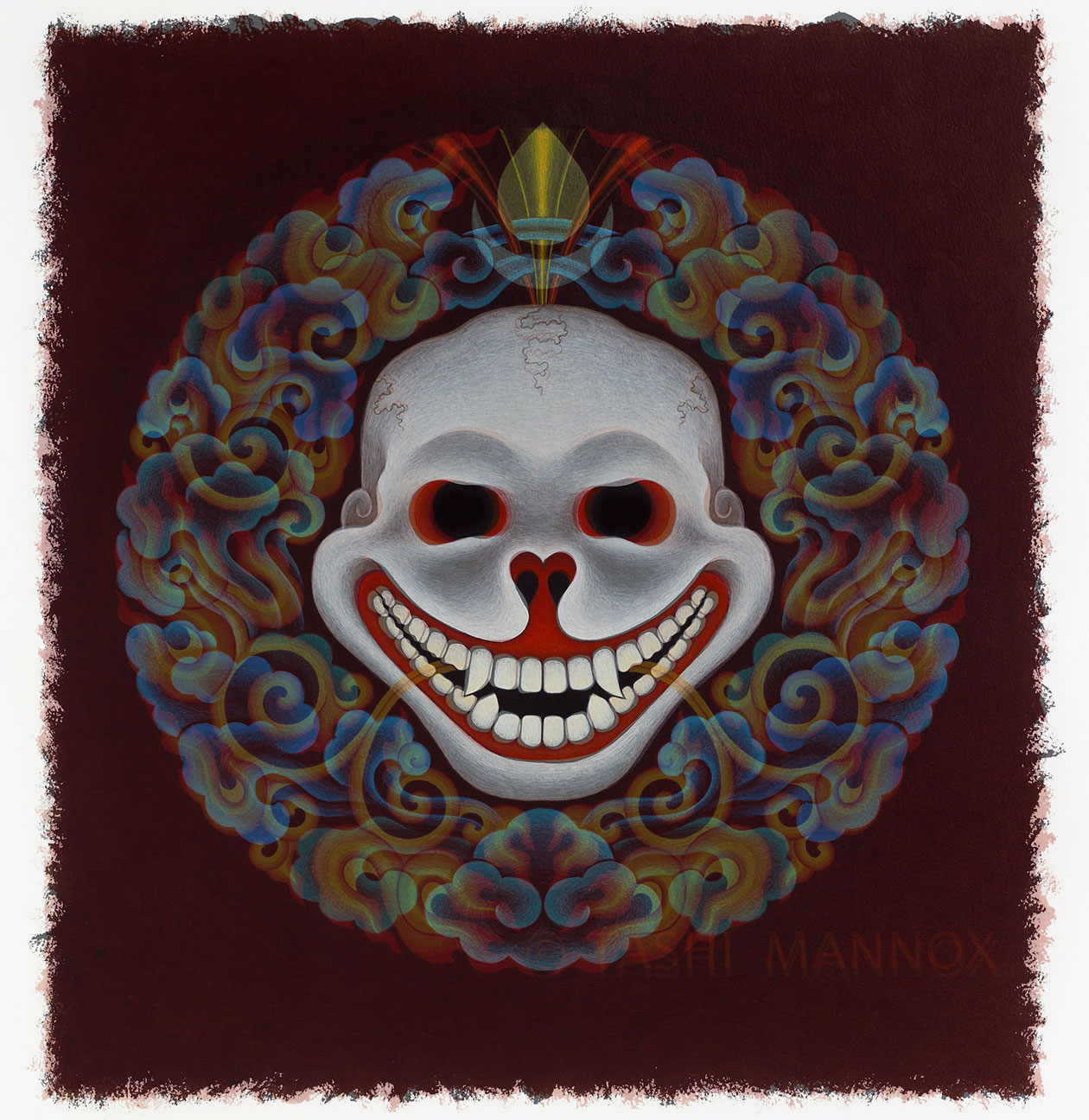
Laughing in the Face of Death: To live and die without regrets.
Created in 2007, this five-piece series has to date never been shown publicly, primarily because the works demand large exhibition wall space to view together in one sequence. Such an exhibition space has not yet materialised. Therefore this full explanation has never been previously published until this new website provided opportunity to do so.
The skull represents impermanence in Tibetan iconography, an emblem of one’s own mortality. Because Tibetan Buddhist practitioners generally have a more positive attitude toward death, the skull is often depicted as laughing in mockery of the inevitable truth.
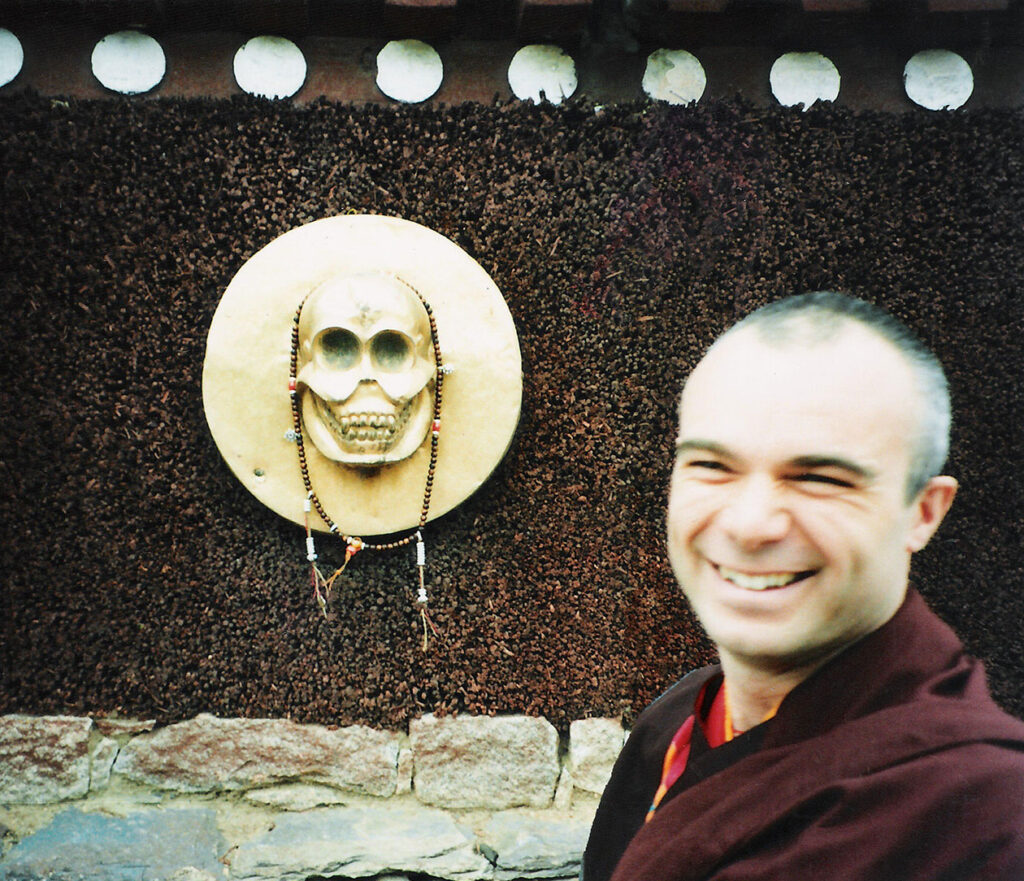
These humorous-looking Tibetan skulls were Tashi’s initial inspiration for the five-skull series, which depicts them as happy yet manically grinning. Each one emanates a different emotion, ranging from a wrathful to a more peaceful expression.
This set of artworks migrates in a particular order from the black skull of death through to a blossoming blue skull of rebirth. This migration is known as the bardo བར་དུ which translates as ‘between stage’.
Each skull is attributed to different negative emotions which can also be understood as transformative opportunities, changing from five ‘mind poisons’ into ‘five wisdoms’—affiliated with the Five ‘Buddha families’.
Tashi has illuminated this popular theme through his own representation, drawing from his training in Tibetan Buddhist arts and philosophy.
He explains:
“A Buddhist practitioner, a Yogi or Yogini, strives to live without harming others and themselves. At the poignant time of death, knowing that they have led a full and meaningful life, they are thus able to look into the face of death confidently, while laughing fearlessly without any regrets. For such a practitioner the time of death is a great opportunity to let go of attachments.
However, as non-practitioners, we do not know ourselves, we cling ignorantly even to the last vestiges of life and fear death, the ultimate unknown.”
On observing Tashi’s five skull renditions, his intention is for the viewer to engage and contemplate each one, which may challenge and pull between attraction to their surrounding embellishments and aversion to the menacing-looking skulls themselves. Engagement may rang from standing back to comparing each skull to one another—perhaps noting the subtle changes in facial expression, mood, and the defining use of rich colour and pattern—to stepping up close to peer into the eternal void-like eyes.
For whatever reason, a viewer usually identifies with one skull in particular, be it the expression or the colourful decoration. This may further relate and question the viewer once the symbolic meaning is comprehended.
“Looking into the faces of the skulls is somewhat like looking at oneself—a suggestion of one’s inner self and emotions, rather like looking into a mirror of the soul: it may not be an entirely comfortable experience, but there is somehow a comforting familiarity that is honest and beautiful at the same time”.
This brings up the general Western attitude toward death, which is considered morbid and often ignored as if one will live forever. Facing images of death may be somewhat uncomfortable, but with the courage of a compassionate heart, one can lighten-up and laugh in the face of death without regrets, overcoming fears and transforming negative emotions into positive wisdoms.
The five art-pieces are individually explained and displayed in a specific left to right order:
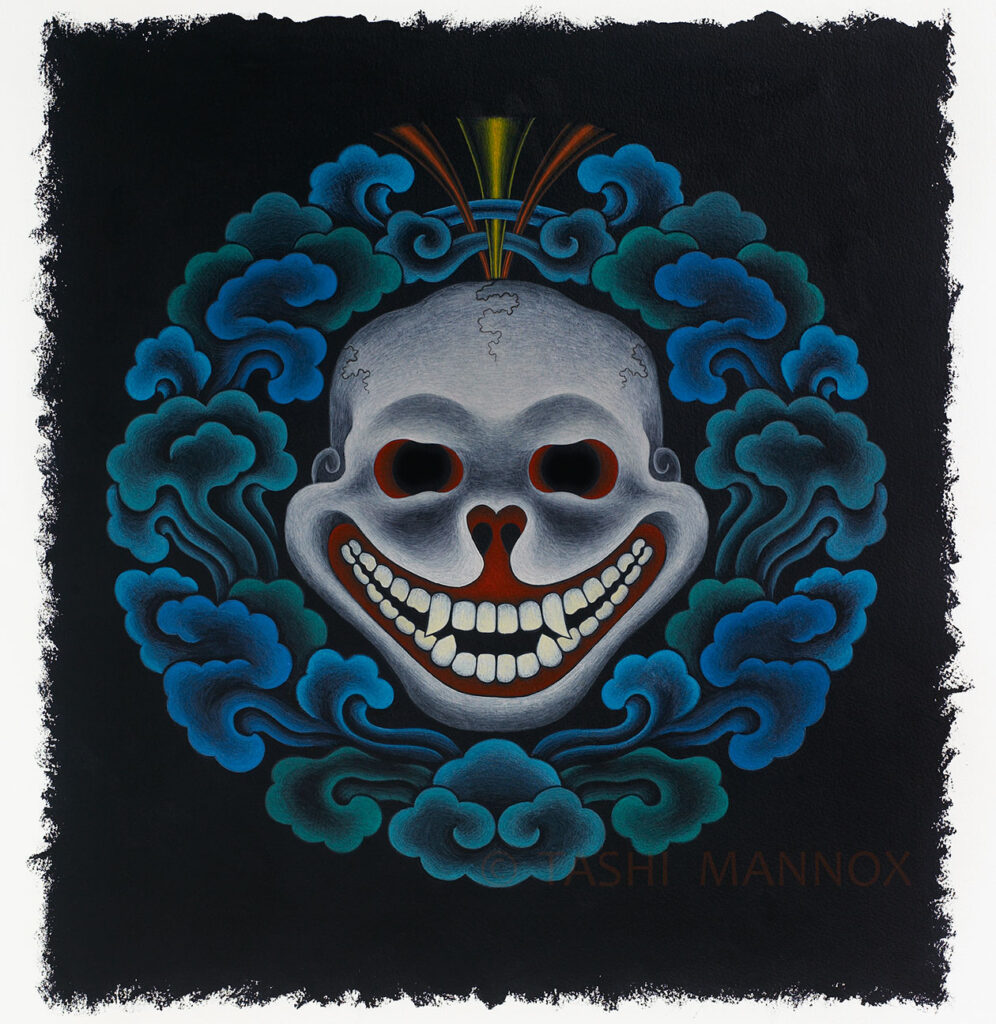
1. ‘Laughing in the face of Anger’
Predominantly black, this first skull commands an angry expression, the most wrathful of all. Rainbow light emanates from the topmost fontanel, illustrating the soul leaving the body at the time of death.
The mood of this piece is one of loss, hovering ghost-like in space, yet piercing indignantly. Rather than quell anger, one must tame it through transformation, converting heated emotion to the deep warmth of loving-kindness. This is the first of the five wisdoms in this series of Five skulls.
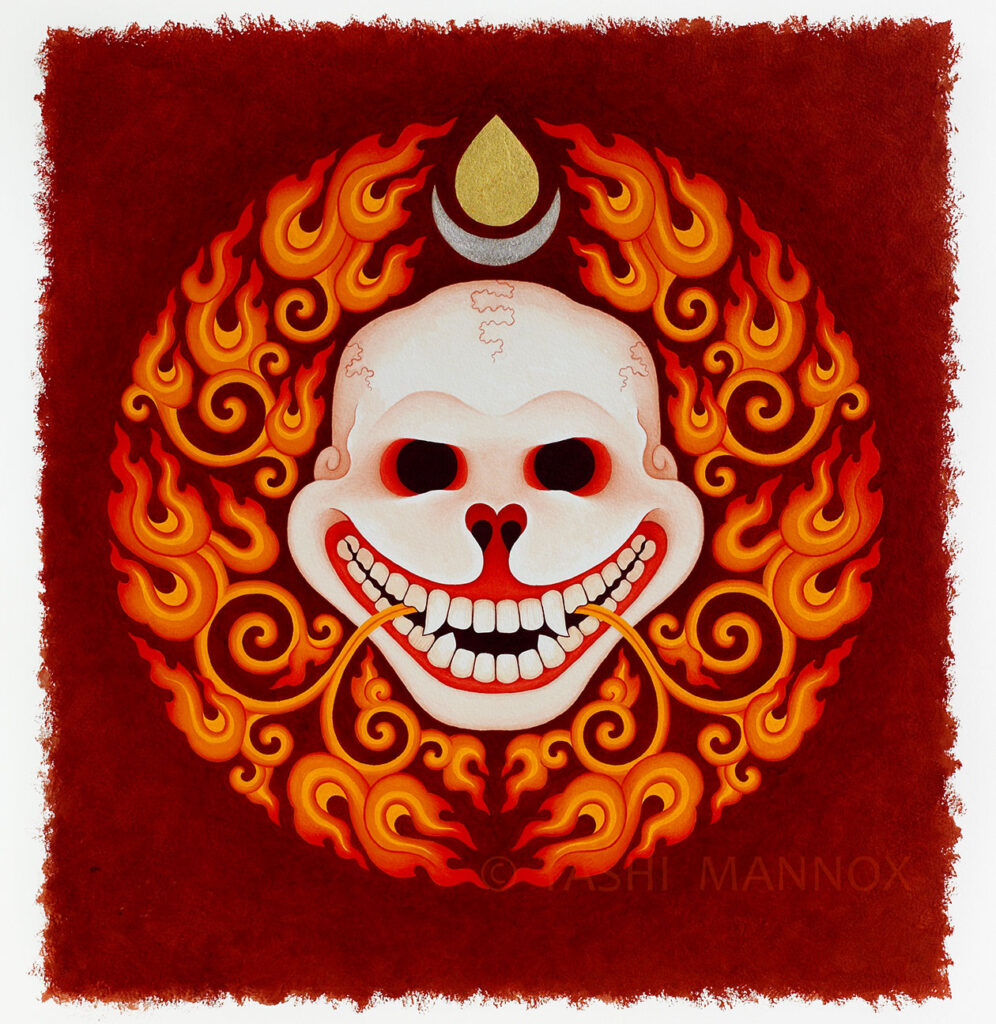
2. ‘Laughing in the face of Attachment’
This next skull is set on a red background, representing passion and attachment. Avarice is all consuming, like a fire that burns up with devastating destruction. The antidote of grasping is generosity, a wisdom of openness.
Above the skull is the insignia of a sun and crescent moon, representing the all important unity of wisdom and compassion.
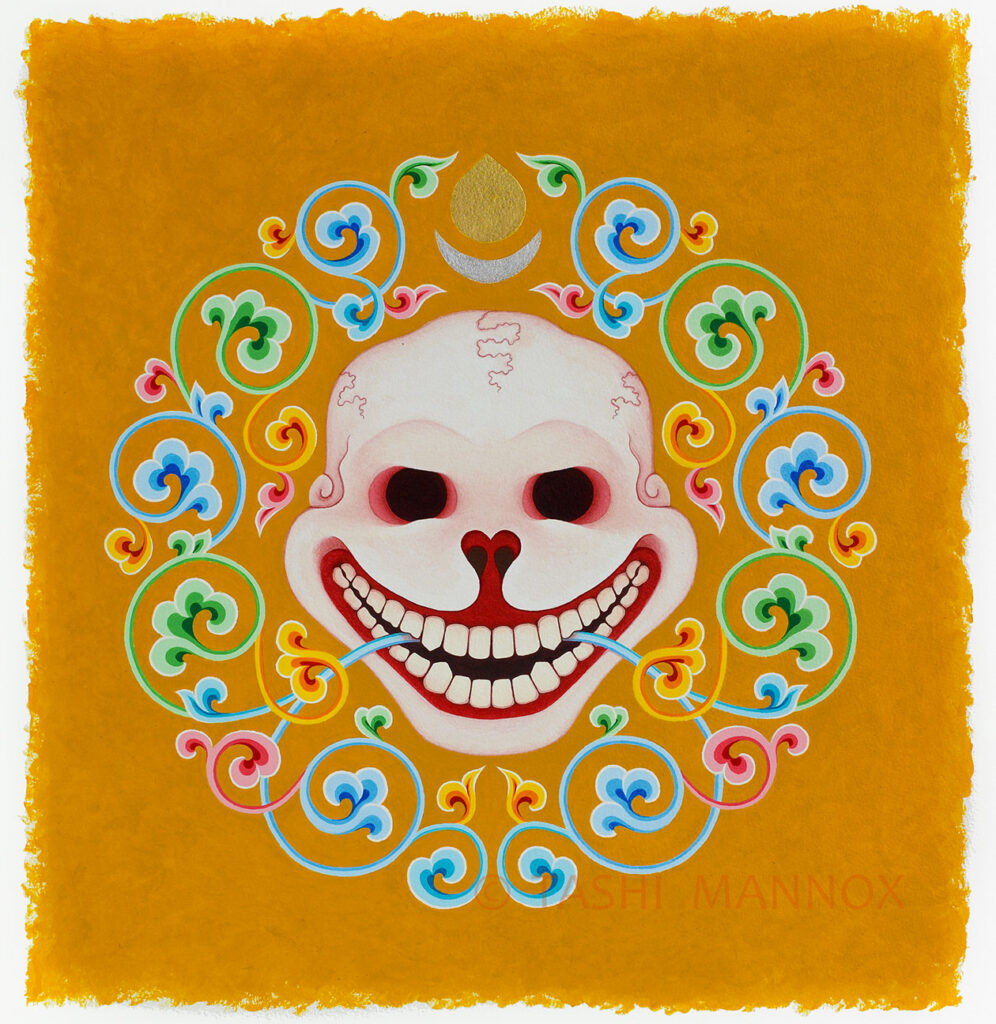
3. ‘Laughing in the face of Pride’
Golden yellow is the colour of riches of the earth and the adornment of the self. The mood of this piece is pride, elaborate and princely. Arrogant pride converts to humility and respect as a wisdom.
Above the skull is the same sun and moon motif.
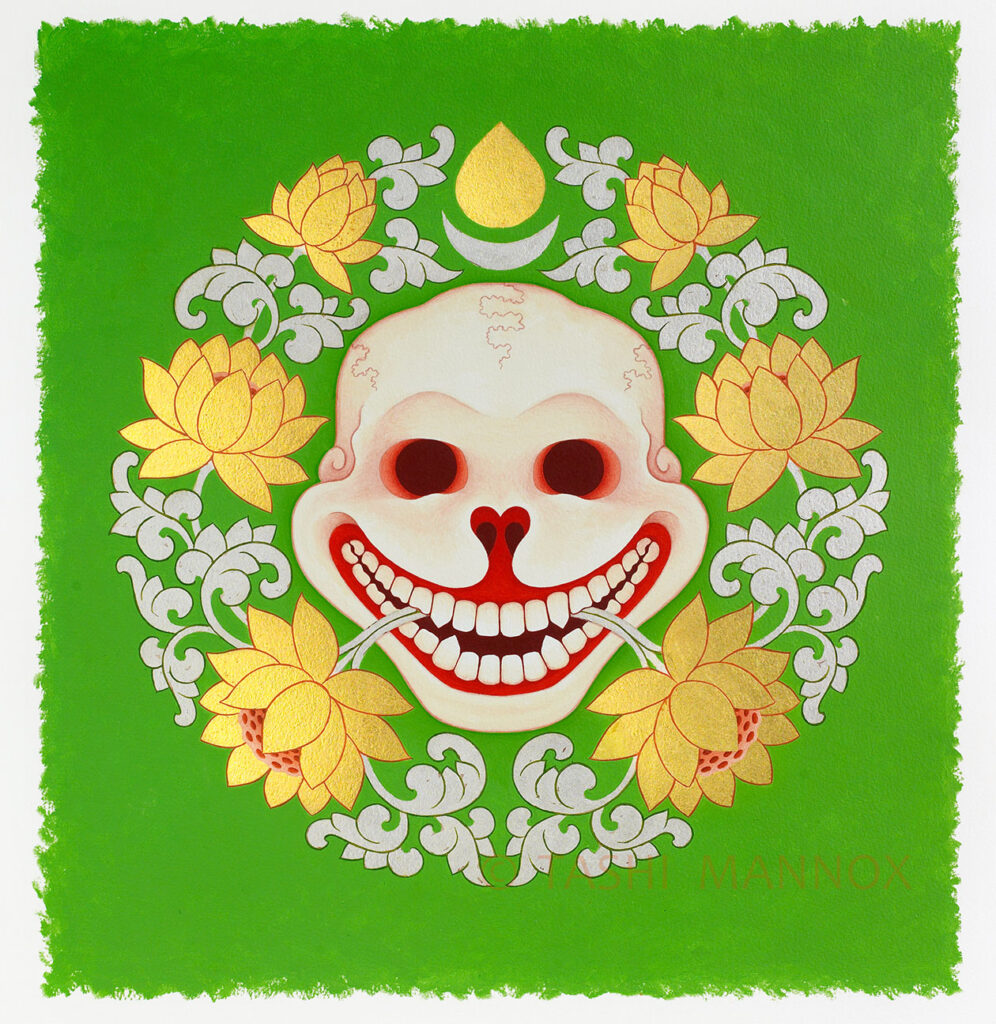
4. ‘Laughing in the face of Jealousy’
Green is the colour of energy and envy. A deluded and sneaky jealous emotion is transformed through the wisdom of equanimity by seeing all as the same.
Above, the sun and moon insignia again emphasise the equally balanced importance of wisdom and compassion.
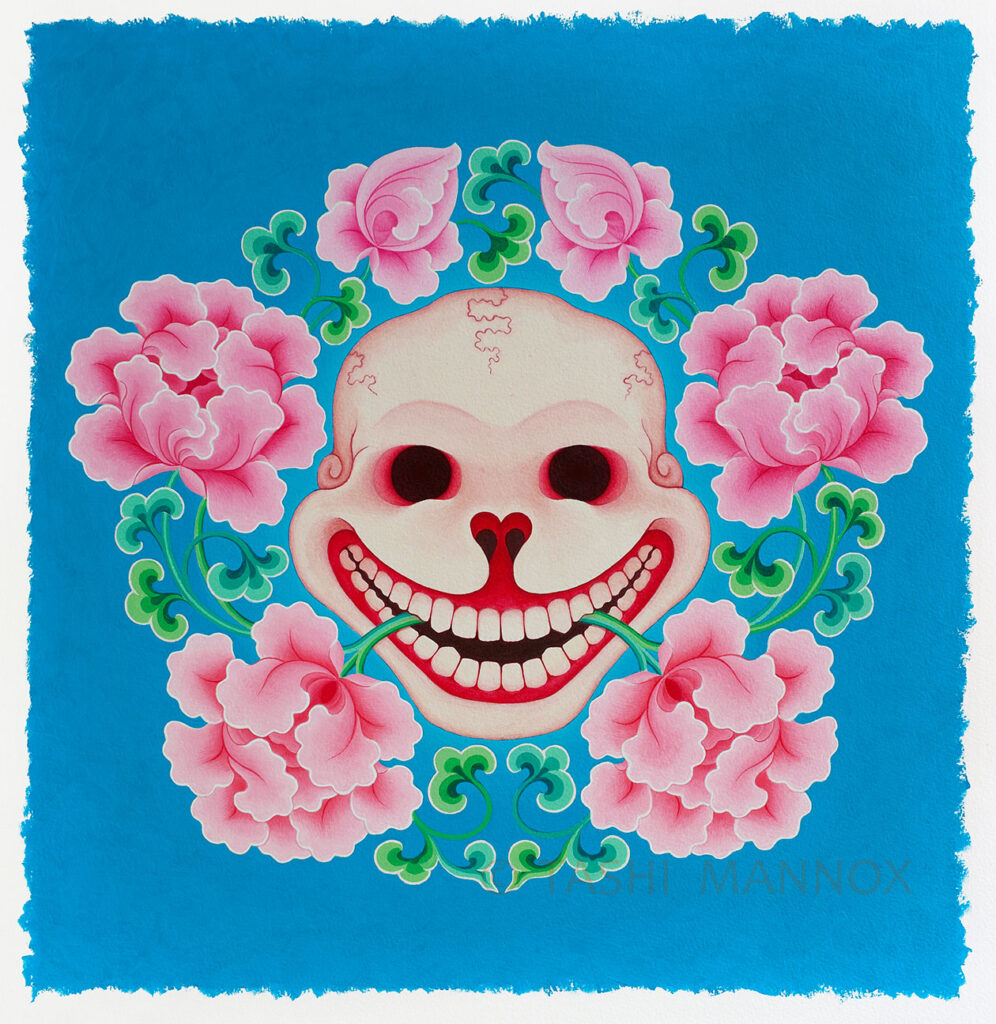
5. ‘Laughing in the face of Stupidity’
Lastly, blue represents the emptiness of space itself. By taming one’s mind, one gains the clear insight to engage liberation from all the above emotions rooted in ignorance. This is the freedom of wisdom, as vast and limitless as the blue sky. Flowers, from the bud of potential, bloom with attainment, full and glorious. As this is the end of the ‘between stage’ (bardo), through liberating wisdoms, this could be considered the end of cyclic existence, symbolised by the top of the skull surrounded by a flower garland of fruition.
Please enquire here for the purchase or licence of this series.